Wednesday, April 5, 2023

YA. When the Yellow Slugs Sing. Limited Kindle edition only $0.99

 "The art of compromise just got slugged, and we love it!"


Purchase your copy of When the Yellow Slugs Sing on Amazon and share a review. Amazon

LINK: On Kindle now for limited time for only$0.99

When the Yellow Slugs Sing is a suspense story written by a teacher to grow awareness of the problem of endangered species and construction development. 

It's the serious story you can't read without laughing.


The Yellow Slug’s Song

Sold

As

Secret pets

Fed crumbs and insects

When plump, Fricasseed—our flesh

Swimming in sauce served with radish

Chef Escargot—our sworn enemy

Twenty-seven thousand teeth

Too small to eat

People

We munch beetles, in the dark, and our divine SLIME!

Goo, ooh, silvery winding trails—sold to scientists. Hire violinists! It only gets worse-er!

Murder! It’s murder. No safe place—surroundings scraped bare for developments.

We get no respect.

Hiding as secret pets, in places, you’d never bet, squirming under beds, munching bread crumbs

Flossing silverfish from our gums behind moist toilets, under damp cabinets, clinging to life,

On cold pipes

Waiting for activists to save our habitats

As we succumb in condos, apartments, brick ranches, 

Purchase your copy of When the Yellow Slugs Sing on Amazon and share a review. Amazon


Thank you!

Stephanie

Saturday, May 29, 2021

Report on Congress: Lax research regulations endanger public safety


Former senior director for Global Health Security and Biodefense at the National Security Council, R. Adm. Tim Ziemer, Dr. Henry Schaffer, emeritus professor of genetics and biomath at North Carolina State University, and Dr. Richard H. Ebright, Board of Governors Professor of Chemistry and Chemical Biology at Rutgers University, weigh in on international biosecurity Feb. and April 2021. Images provided.

America may fund the next deadly pandemic because most virus research across the globe is federally funded, and incompletely regulated. It is no longer a conspiracy theory that the 2019 pandemic may have begun from a lab and a new NCBI autopsy report shows the RNA vaccines invade the entire body and questions the effectiveness of vaccinating.

 Scientific research on life-threatening organisms that can spread to humans is conducted daily and the system to report accidents, thefts, loss and misuse is voluntary. The system is called biosecurity and biodefense and Congress has not stopped the public safety threat, as the 2019 pandemic exemplified.

Congress has a history of reacting with new policies to address biological disasters. For example, in 2014 the Blue Ribbon Study Panel on Biodefense assessed gaps in policies, added improvements and the panel issues updates, but it is only policy.


One example of Congress placing a policy over a life-threatening problem was in June 2020 when the director of Global Affairs in the U.S. Department of Health and Human Services reminded Congress that the International Health Regulations had already been revised after China failed to report a 2005 SARS pandemic. The revised policy was written to improve transparency and reinforce obligations to report outbreaks.

But policies did not stop the 2019 novel coronavirus pandemic and federal funding in China for research on potential pandemic viruses continues.

No International Biosecurity System

“The framework is there” to mandate controls of research, “but part of the problem is it does not extend internationally,” R. Adm. Tim Ziemer said in his first interview since leaving the White House in June 2018.

International tactics is a skill Ziemer polished during his 30-year U.S. Navy career as commander of the Mid-Atlantic Region. He served under Presidents Bush and Obama in a historic malaria initiative saving over 6 million lives by reducing malaria by 50%. 

Former President Trump asked Ziemer to serve in the National Security Council for Global Health Security and Biodefense. Ziemer had international biosecurity goals and said they merged the four primary agencies which had biodefense protocols and created a consolidated set of objectives.

But in 2018, when John Bolton, a well-known anti-military strategist, was assigned as the new National Security Advisor, the merge was dissembled and the goal for a strong pandemic response was lost.

AUDIO link to interview with R. Admiral Tim Ziemer Feb. 2021


Research on Potential Pandemic Viruses

The U.S. Government has known potential pandemic research was not properly controlled since 2011 after lab accidents with “controlled” pathogens, but Congress still funded potential pandemic virus research under the same regulations, including coronaviruses.

Plus, the U.S. Government funded this type of research in China, which is known as the “greatest threat to democracy and freedom” since World War II, according to  John Ratcliffe, the top U.S. intelligence official, in a Dec. 2020 BBC news report.

However, a policy is only a rule and rules get broken every day.

Besides, the U.S. Government also allows the sale of Do-It-Yourself DNA modification kits. Vials of DNA and scientific elements can be purchased online.

“And if you have trouble buying it, go into a lab and steal it or go into a biology lab at Pembroke [University of North Carolina] and find a nice young lab tech, or not so young, and say, “Here’s a hundred bucks. Would you mind getting me a vial of something out of the refrigerator?” Dr. Henry Schaffer, emeritus professor of genetics and biomath at North Carolina State University (NCSU), said about preventing misuse with policies and pressure, “People steal and take bribes.”

VIDEO link to interview with Dr. Henry Schaffer of North Carolina State University  

Dr. Henry Schaffer of North Carolina State University discusses the trials of scientific research on Feb. 18, 2021 with Stephanie M. Sellers via Zoom.

Schaffer now works for NCSU installing the National Institute of Technology’s intelligence theft protective software, SP 800-171, that is required for federal funding and is familiar with research security from both the lab and technological aspects.

“I am confident [China] has in its government structure, packing shops that spend their days and nights working on trying to get into U.S. Government computer systems, corporate systems, and so on,” Schaffer said.

The opportunity for misuse of research is seen in its ability to guide vaccines, create wealth, tax exemptions, fame and to create fear and control. For example, a virus could be held as a threat to bring a country to its knees, according to Ziemer.

Public safety is also compromised when high-risk research is conducted strictly out of curiosity, according to the Board of Governors’ Professor of Chemistry and Chemical Biology at Rutgers University, Dr. Richard H. Ebright.

Public safety is compromised when potential pandemic viruses are not researched in a lab designed for the specific agent. SARS, which is the foundation of the novel coronavirus is an agent that requires at least a BSL-3 lab. A BSL-3 lab is designed to protect workers from inhaling viruses, according to the Biosafety in Microbiological and Biomedical Laboratories.

“However, all coronaviruses other than SARS-CoV-2, SARS-CoV and MERS-CoV--even bat SARS-related coronaviruses deemed to pose a clear and present danger for pandemic emergence--currently are assigned as BSL-2 pathogens. This is an inappropriately, irresponsibly, indefensibly, lax biosafety standard and urgently requires revision,” Ebright said. “Currently, have a strictly Wild West system in terms of biosafety and biosecurity.”

Moreover, there is no sufficient oversight to prevent high-risk research that will not produce new information that has potential to benefit the public in some way, such as with a cure or a vaccine, according to Ebright, who said the biosecurity system is deficient because it lacks oversight and it should be international.


Check out the interactive infograph titled Throwing money at a dead horse.


“If you have a system of guidelines that is not enforced and for which there are no enforcement measures and no sanctions, when someone is out of compliance, that system of guidance will be ignored, and that is clearly what has been happening in biosafety in the U.S. and China,” Ebright said.

In 2003, Taipei and Singapore lab researchers were infected with SARS and in 2004, Beijing had two infected. The WHO advised inventory checks, meetings on policies and attending WHO safety workshops. That was almost 16 years before the 2019 pandemic and the U.S. Government, which funds virus research across the globe, continues to let risky research be self-reported, conducted without beneficial purposes, and in the hands of those deemed a threat.

The 2019 Annual Report of the Federal Select Agent Program contains a 31-page explanation of scientific research incidents and the theft, loss and release, which includes being bitten by an infected lab animal, of biological select agents and toxins (BSAT) such as coronaviruses, anthrax and H5N1.

In 2019, there were 247 labs registered to handle BSAT and of those, 189 were inspected.

There were 219 reports of BSAT release. Most of the release problems originated from defects in personal protection equipment, such as tiny holes in gowns and ill-fitting helmets. Other problems were from equipment designed to protect from infectious aerosols, and there are nine reports of BSAT loss from labs in 2019 still pending FBI determination.


Nine reports BSAT loss from labs in 2019 is still pending FBI determination.


Ebright said the biosecurity system is lax and “as a basic rule of thumb we have not let medical doctors regulate themselves,” but for biological research, they regulate themselves.

The Investigation into Origins of the Novel Coronavirus

Investigations into the origins of the novel coronavirus continue. Look at the relationships of these agencies and people and decide if they are compromised.

Dr. Peter Daszak, president of EcoHealth Alliance, has worked as a famous zoonotic disease expert with China’s Wuhan Institute of Virology, which is federally funded for gain-of-function research by the U.S. Government, for over 15 years.

Daszak’s federal funding was cut after the pandemic began and later restored when Daszak began investigating the origins of the novel coronavirus with the World Health Organization (WHO).

It is interesting to note that China’s Wuhan Institute of Virology gave the University of North Carolina at Chapel Hill’s (UNC-CH) researchers, who worked in Dr. Ralph Baric’s lab, the horseshoe bat CoV sequences to create their SARS-like virus.

And as early as 2016, Baric and his team released a study titled, “SARS-like WIV1-CoV poised for human emergence,” and it stated more vaccine research was needed.

This research was conducted during a U.S. Government moratorium on infectious disease research. Under the moratorium, gain-of-function research would not receive funding but research in progress would not be cut or stopped, and neither would vaccine research, such as Baric’s.

According to an Aug. 2020 Nature article, Daszak said the novel coronavirus did not begin in a lab.

However, in a Dec. 9, 2019, just three weeks before the pandemic, in a TWiV video at the 28:10 mark, Daszak said while working on SARS research in the lab setting that the SARS virus can get into human cells.


VIDEO link to interview on TWiV 615 with Dr. Peter Daszak

TWiV 615: Peter Daszak of Eco Health Alliance is interviewed Dec. 9, 2019.


The above contradiction may be a compromise in the investigation and it is further complicated by a Feb. 9, 2021 tweet when Daszak said American Intelligence was not to be trusted about their investigation.

Economically, the investigation is complicated by the National Institute of Health choice to restore Daszak’s multimillion-dollar research and increase it to $7.5 million. The New York Times reported that of the total $123 million in government funding Daszak’s research has received, one third was from the Pentagon.

President Biden chose Jake Sullivan as his National Security Advisor. Sullivan, like Daszak, does not support American Intelligence, according to his interview on CBS Feb. 21, 2021. Sullivan blames Bolton’s dismantling of Ziemer’s military-style consolidated biodefense.

Still, newly unclassified information shows China’s Wuhan Institute of Virology had persons with flu-like illness in the fall of 2019, according to former Asian Affairs director for the National Security Council, Matthew Pottinger, in a Newsmax article.

“If the agency that is doing the oversight is also carrying out the work [research] or funding the work, that is errant conflict of interest. That almost by definition, ensures that the oversight will be lax and that is, of course, what we have currently,” Ebright said.

The truth of origin may not come to light for generations but the facts are that an international biosecurity system should be in place and it is past time to lasso the Wild West of scientific research, but wranglers will need miles of rope.

Because in 2005, the U.S. Government made pharmaceutical companies exempt from liability when creating vaccines during a pandemic. It is not clear if less pressure for the gold standard in meeting FDA requirements led to rushed FDA releases of the trial vaccines and the increase of reported side-effects and vaccinated persons becoming reinfected.

But the drive to create vaccines under federally funded gain-of-function research, like the novel coronavirus, may be why the rush to research while dodging public safety has been trotting along at a steady pace.

The novel coronavirus vaccines are expected to generate billions in 2021. Pfizer is expected to make at least $15 billion in 2021 alone, according to its quarterly report and production agreements. Moderna is expected to make $18.4 billion and Johnson & Johnson is expected to bring in $10 billion, according to their financial reports.

However, hydroxychloroquine costs pennies in comparison and in April 2020, the Association of American Physicians and Surgeons (AAPS) showed evidence of effectiveness.

“The HCQ-AZ combination, when started immediately after diagnosis, appears to be a safe and efficient treatment for COVID-19, with a mortality rate of 0.5% in elderly patients. It avoids worsening and clears virus persistence and contagious infectivity in most cases,” AAPS said.

Besides, Daszak said in the TWiV video that humanized coronaviruses are "untreatable with therapeutic monoclonals [lab-made antibodies] and you can’t vaccinate against them with a vaccine."

In the video, Daszak describes different types of coronaviruses used to make the vaccines for the novel coronavirus. For the average listener, it is not certain which bat coronaviruses are used to make the vaccines.

One thing is certain. Public safety will be at risk until Congress creates international policies that work under a rigid oversight program.


By Stephanie M. Sellers

Journalist

gaumedup@gmail.com


Sunday, May 24, 2020

Synopsis of chapters in The Exsanguination of the Second Society: Scholarly Historical Fiction Relating to Robeson County, North Carolina’s Tuscarora Natives

Synopsis of Chapters for The Exsanguination of the Second Society: Scholarly Historical Fiction Relating to Robeson County, North Carolina’s Tuscarora Natives


Chapter 1, The Vexing Now, provides an enticing lecture on the Mighty Tuscarora and colonial period. This section is heavily annotated. Chapter 1 asks serious questions of the reader on how to best preserve one’s culture and introduces the local vernacular and identifies 21st century issues facing Robeson County, NC Natives and citizens.

Chapter 2, Cut of His Jib Now, demonstrates how difficult it is to break cycles of behavior while it also exposes prejudice in belief systems. Children taught that Robeson County, NC people are Lumbee and not Tuscarora will struggle as adults when they attempt to explain their true Tuscarora heritage. Chapter 2 carries the shadow chapter of 1, because the writing team was formed in the first chapter and was not available to read until Chapter 2. In The Vexing Then, a traumatic event reveals the bond between the main characters, despite their separate ethnic identities and belief systems.

Cut of His Jib Then mirrors the relationship of the federal government with Native Americans as “Dan the Man” symbolizes the federal government. Preacher Lilly symbolizes the seduction of money. Mrs. Wilkes, Jake’s mother, symbolizes present culture’s self-centeredness, lack of involvement, and to a degree, political correctness. Mr. Wilkes represents conservative whites. The “store church” represents the fallacy of a just government as it pertains to relations of people whose ancestors were the victims of the government’s genocide mission.

Chapter 3, The Game of “Dare” Now, capitalizes on the importance of names in the 21st century, while its shadow chapter relays the importance of the Elizabethan era vernacular’s influence. Human behavior becomes an interesting indicator of the Robeson Peoples heritage and includes annotations. The Game of “Dare” Then presents elements of danger and mystery which increase as the young men agree on a “daring project.” The battle between the 65k Lumbee Empire and the 4k Tuscarora escalates via undercover thugs.

Chapter 4, Between the Lines Now, continues the exploration of name originations and carries annotated testimony from honored history professors on the possibilities on the “traded” Native American languages and a regionally honored history professor’s statement that he is descended from The Lost Colony. The tradition of oral history is magnified. The erasure of Tuscarora history is established, and the magnitude of political conspiracies is revealed. Between the Lines Then serves as a “satirical” foreshadowing of the Bureau of Indian Affairs’ questionable relationship with Undercover detectives, the Federal Bureau of Investigation, and Indian activists during the 1970’s, by providing an action-packed adventure with unexpected outcomes as the young boys work to complete their “daring project.” Each of the chapters reflect conspiracy as nothing is as it seems.

Chapter 5, The Good-Old-Boys Club Sucks Now, reveals the conspiracy against the true history of Robeson County, NC Peoples. The 1973 Bureau of Indian Affairs in Washington, DC’s occupancy by Trail of Broken Treaties Indian activists is revealed as an unsettled angst amongst Tuscarora today. The shadow chapter rides this same train but experiences a significant “hold-up.” Fast-paced and short, the shadow chapter drives the reader toward a collision when Miss Lucy reveals her heritage.

Chapter 6, The Cycle of Mayhem Now, begins by revealing that some characters have not been totally forthcoming and those who have been, are now paranoid. By now, it is also clear that the white characters, primarily, Jake Wilkes, a lead character and his co-author, Miss Lucy, are in the role of symbolizing government ideals as they try to figure out what is the best thing to do while their lead Native American representative is unavailable to properly represent his Tuscarora family. This is indicative of the present 2020 situation among Robeson Indians today as their history has been abused and erased until only a few thousand Tuscarora plan litigation to improve their government to government position because some have purposefully denied their true heritage or needed to take advantage of economic offers by enlisting in the Lumbee Tribe. This chapter and shadow chapter’s storylines captures the dilemma of a one-on-one relationship between a trusted representative from each side, as reflected in the Trail of Broken Treaties’ investigation.

Chapter 7, Pirate’s Blood Now, reveals that even the closest of allies have secrets. Jake’s paranoia rises as deeply rooted resentment against the 1600’s era English is established. Pirate’s Blood Then exposes the deeply rooted relationships between groups within the Robeson area. The vernacular is reinforced as a binding community language. Prejudice and oppression are exposed while more details on the historic amalgamation of the Robeson area Peoples are revealed, along with a tour of an “Underground Railroad,” after which Bruce becomes empowered as he deals with “exsanguination.”

Chapter 8, Agotsinnachen Now is a short impactful section that stresses the danger element when helping the underdogs, the Mighty Tuscarora of the 21st century.

Agotsinnachen Then provokes empathy as it provides clues when the winos, Mr. Fisk and Wart, who symbolize the white swindlers of the colonization period “lose” their prized possession and a snake battle symbolizes the historic Tuscarora war. Characters reveal intentions as tensions flare.

Chapter 9, Stolen Treasures Now reveals that Jake Wilkes is committed to helping all the people of Robeson County overcome their self-existential crisis. This chapter is heavily annotated as Jake has furthered his research and grown more determined. The shadow chapter is extremely brief and reveals that Miss Lucy and Jake are no longer in imminent danger, but the answer as to why they are not in danger is only revealed through the actions of the last chapter.

Chapter 10, In the Wind Now, delivers the main character in a surprising new setting as he adapts to truths he had previously denied.

In the Wind Then: This is presented as Chapter 1, In the Wind Then as it bears the story of how a heart is rekindled with family and friendship’s warmth while exposing how North Carolina’s Tuscaroras survive - in the wind.

   Follow my Blog

Have copies of historic treaties and access to NC Tuscarora lineage charts delivered to your inbox - and more! 


Notes, acknowledgements and stuff you might want to know about The Exsanguination of the Second Society

In 2020, North Carolina’s Lumbee Tribe was a state recognized group of 60,000 members, according to the Dec. 5, 2019 federal recognition hearing. In April 2020, the tribe increased to 65,000, as citizens hoped for recognition.
In 1885, citizens “voted” on the Lumbee name under the guise of a lawyer, Hamilton McMillan. This historical fiction shares the details of how this choice was actually made. The Lumbee receive financial assistance based on economic disparity rates. More members means more money.
The University of North Carolina at Pembroke (UNCP) hosts The Southeast Museum of Native American Indians. Tuscarora names, films, artifacts and their legendary heroes are choked to death with Lumbee ideology. The Lumbee Tribe claims the NC Tuscarora are a “splinter group” of the Lumbee in order to prevent the Tuscarora from attaining their own government recognition, and in hopes that the Tuscarora will submit to becoming members of the Lumbee Tribe, thus increasing the association’s state funding.
The Exsanguination of the Second Society: Scholarly Historical Fiction Relating to Robeson County, North Carolina's Tuscaroras serves to address the Tuscarora cover-up with entertaining characters and unexpected twists as the true history of North Carolina’s Central Eastern Natives is revealed. The storyline serves to reveal the underground civil war while the scholarly references reveal the facts. 
This book carries a plethora of annotated history and follows the storyline: The main character is desperate to help his childhood friend, whose death made headlines.
Thank you, Donnie Red Hawk McDowell, a graduate of UNCP with a Bachelor’s in Native American Indian History, a lifetime Robeson County, NC resident, and Tuscarora, for your generous time, shared knowledge and for providing the realism of a warrior.

Donnie Red Hawk McDowell. 2020.

Dr. Peter H. Wood, emeritus history professor at Duke University, shared his report with me and then agreed to allow Tuscarora Roots: An Historical Report Regarding the Relation of the Hatteras Tuscarora Tribe of Robeson County, North Carolina, to the Original Tuscarora Indian Tribe to be included in UNCP’s library’s Special Collections. It was submitted January 7, 2020 and it is now May 24, 2020 and it is still not active in their library. But the report can now be read at the larger institution unencumbered by administrative censorship, the University of North Carolina at Chapel Hill. The report contains an indigenous report, genealogical evidence and points to false narratives which have prolonged the oppressiveness suffered by these aboriginals. The Tuscarora descendants’ charts list Locklear, Lowry, Chavis, and Cumbo.
Each of Wood’s references in his report have been verified.
Narratives are evaluated by verifying the reference with its annotated narrative. When a suggestive reference includes several full-length books without page numbers, speculation to false narrative is a concern. The UNCP library has several reference books on Tuscarora history and the making of the Lumbees and their lives now which contain erroneous references.
In 2019, Dr. Peter H. Wood of Duke University wrote a testimony for the Tuscarora Nation of North Carolina. He earned a BA and PhD at Harvard University.  He attended Oxford University on a Rhodes Scholarship, and in the early 1970s, worked for the Rockefeller Foundation.  While there, Wood oversaw grants to Native American scholars and institutions.  (One recipient was the late George Horse Capture (Gros Ventre), who later became a leader at the National Museum of the American Indian.) 
“The effort to reassert Tuscarora identity more publicly during the early 1970s was viewed by some as a manufactured pose in an activist era.  But in fact, it represented an acknowledgment of roots that were extremely deep.  These ties had been obscured by generations of speculation about how all the Indians of Robeson County might best be lumped together under one title.  The recognition of the Lumbee in 1956 should not limit or constrain any Tuscarora recognition claim,” Wood wrote in his testimony.
Thank you, Dr. Wood, for your dedication.

    Follow my Blog

Have copies of historic treaties and access to NC Tuscarora lineage charts delivered to your inbox - and more!

A synopsis of The Exsanguination of the Second Society: Scholarly Historical Fiction Relating to Robeson County, North Carolina’s Tuscaroras and "the" UNCP article

The Exsanguination of the Second Society: Scholarly Historical Fiction Relating to Robeson County, North Carolina's Tuscaroras is a book within a book, set in rural North Carolina in the year 2020. Each chapter has a shadow chapter, i.e., Chapter 1, The Vexing Now, Jake’s present life, is shadowed by Chapter 1, The Vexing Then, Jake’s past life, which is a draft of a collaborated book with a librarian written out of desperation. Psychohistory binds the chapter versions while a love story propels the reader to learn if Jake Wilkes “bakes an apple pie” for his proposal as a love triangle’s roots are exposed and a tribe is threatened with extinction.

The Lumbee Tribe recently “shadowed in” NC’s Tuscaroras as a “splinter tribe,” without their consent, thusly oppressing their heritage and efforts for reparations.

This shadow-chapter method works to serve as a demonstration of human behavior in how political decisions are made. It demonstrates how time has changed the region’s culture thusly affecting perspectives during adaptation periods while it also highlights what does not change. This method highlights the region’s endangered vernacular as a social language that binds community. During interviews, as people grew relaxed with me, both Lumbees and Tuscaroras used more of the region’s vernacular.

Most importantly, it highlights the endangerment of the factual history of NC’s Tuscaroras, early victims of colonization in forced removal from their own lands. It draws attention to how the People have been victimized by colonization’s limited scope of preservation, by land swindlers, by political persuasion, and widespread bias and oppression, much of which has been culminated from false narratives, ultimately fulfilling the original white philosophy of “kill the Indian, save the man.”

 Seventy-five annotated references are within the body of the story. From an instructional aspect, the presentation of the facts provokes curiosity in learners: It encourages research. The Then chapters are designed to attract young readers and serves as a relief from the Now chapters which are heavier with facts. The shadowing methods demonstrates how behavior patterns within different eras transcend timelines.


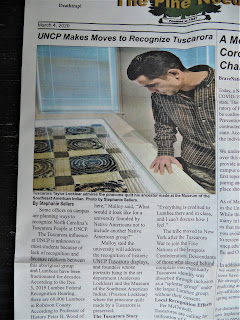
This newspaper clip is from the University of North Carolina's The Pine Needle. Read all about "the article" on my blog post "Events leading to the construction of my latest book, The Exsanguination of the Second Society: Scholarly Historical Fiction Relating to Robeson County, North Carolina’s Tuscarora Natives."

    Follow my Blog

Have copies of historic treaties and access to NC Tuscarora lineage charts delivered to your inbox - and more!

Events leading to the construction of my latest book, The Exsanguination of the Second Society: Scholarly Historical Fiction Relating to Robeson County, North Carolina’s Tuscarora Natives


Photo of Preston Locklear is erroneously labeled as Lumbee in the Museum of the Southeast American Indian.  

Preston Locklear has been identified as Tuscarora by Dr. Wood in his descendants' charts in "Tuscarora Roots." Preston Locklear's descendant, Donnie Red Hawk McDowell and others have notified the museum and the curator has a copy of the descendants' charts. The hope is that the museum will correct this soon, as well as other mislabeled exhibits. 

During the research phase, I found Dr. Wood's report and asked for use of his report and he agreed and also agreed to share it in libraries. 
To read Dr. Peter H. Wood's Tuscarora Roots: An Historical Report Regarding the Relation of the Hatteras Tuscarora Tribe of Robeson County, North Carolina, to the Original Tuscarora Indian Tribe, see: 
Research and Instructional Services Department

Wilson Special Collections Library

The University of North Carolina at Chapel Hill


The Exsanguination of the Second Society: Scholarly Historical Fiction Relating to Robeson County, North Carolina’s Tuscarora Natives is my latest work. As Bruce Black’s life turns from moonshine to fine wine, he gains the power to solve ancient mysteries threatening to bleed out the Tuscarora ascendancy.

    Robeson County, North Carolina is home to 65,000 state recognized Lumbee Indians, and home to the longest “Hatfield and McCoy” feud in written history. Many Lumbees resent the NC Tuscarora because they have proof of their Native history.
    I had heard the rumor of systematic corruption to keep the Tuscarora history hidden and did not believe it until it was in my face. The Natives’ history was so suppressed that even the university's newspaper’s academic advisor did not know of their existence in the community, along with most students. After interviews, research, and being terminated as a student reporter after a barrage of complaints from Lumbees, I became a firm believer in the corruption.
    The University of North Carolina at Pembroke’s student newspaper’s March 4, 2020 edition of The Pine Needle printed the first article of my investigative series, “UNCP Makes Moves to Recognize Tuscarora.” To appease the Lumbee complainers and suppress the truth by blocking the upcoming series, I was terminated by email on March 14, and the paper published a retraction the next week. Termination was changed to suspension to fit legal codes. I am a student, paying for a newspaper writing class and there is no binding contract for student reporters. 
    I was told that the university had been barraged by complaints about the article, specifically the title because it included the word recognized in the same sentence as NC’s Tuscarora. The Lumbees Tribes’ Federal Recognition hearing on Dec. 5th had been marked when the Cherokee Chief touted the Lumbee identity shopping pattern, and this further fueled the hate. Because long ago, the Lumbee had attempted to claim NC’s Tuscarora identity, and were again denied.
    When I was told that the termination was changed to suspension and “could be permanent,” I heard the systematic corruption loud and clear: If the retraction did not appease the Lumbees, my student reporting was over. I also heard it in the department chair’s repeated reference to “our Lumbees” with no empathy toward our Tuscaroras. The chair had expressed empathy when I had sought advice on the construction of the article, but after the Lumbee complaints, it had completely vanished.


    At the campus cafeteria, students had confronted me with gaslighting statements, and I offered them assistance in dealing with the reality of the Natives living among them. For those who were too biased to explore new research, I suggested that they reread the article. But deep down, I knew it would take more, like volumes of research, so I chose to share mine in The Exsanguination of the Second Society: Scholarly Historical Fiction Relating to Robeson County, North Carolina’s Tuscaroras.
    I pray that this book is read by all Lumbees.
    I was in the editing phase of this book when this hate became nasty and knew it was past time for the truth. So, during the new coronavirus pandemic, forced into isolation, the book was released.
    Newly organized research and interviews are incorporated into this narrative. It was written during the initial stages of the 2019 Tuscarora grassroots movement urging Lumbee Tribe members to research the facts on their heritage and for those who match NC Tuscarora descendance to disenroll from the Lumbee Tribe. There are only a few thousand NC Tuscarora whose heritage is verified with descendants’ charts.
    One of the exciting features of this book is that the history unfolds as it is learned by the characters. Their realistic personal reactions are fresh and vivid.
If you enjoy reading history, you will love The Exsanguination of the Second Society


   Follow my Blog

Read this book for free at the University of North Carolina's Special Collections Library and at Wilson Special Collections Library.


Upcoming Book Release: Sci-Fi YA crossover, Amagi

Book Club and Teacher's Study Guide for the Jim Jones Story: Death in the Jungle by Candace Fleming

  Buy Your 102-Page PDF Copy Today email Amagiscifi@gmail.com PayPal $15 The EZ Essay Study Guide explains Jim Jones' brainwashing techn...